
Quick Summary
This guide explains the critical difference between mechanical debris removal and EPA-registered antimicrobial treatments to help homeowners secure the best air duct sanitizing in Bridgeport for improved indoor air quality. Redwood Air Duct Cleaning Service Bridgeport delivers premier local solutions by pairing thorough diagnostic HVAC inspections with targeted antimicrobial applications on nonporous surfaces without hidden fees or corporate delays. Readers will understand how proper sanitization restores system efficiency and can immediately contact the team to request a free, no-obligation estimate or text to schedule same-day service.
Best Air Duct Sanitizing in Bridgeport: Cleaner Air and Honest Service
When considering air duct sanitizing in Bridgeport, professionals like Redwood Air Duct Cleaning Service Bridgeport note that it is helpful to understand general indoor air quality factors and the role of HVAC treatments. Ventilation, humidity, HVAC operation, building materials, cleaning products, and other pollutant sources all affect indoor air quality.[4]
Indoor air quality is influenced by how air moves through a building. Most forced-air systems do not mechanically introduce outdoor air unless a dedicated ventilation component is present, and low air exchange can allow pollutant levels to increase over time. When issues like musty odors or visible debris arise, addressing underlying moisture and contamination can help manage indoor air conditions, though cleaning and sanitizing alone should not be assumed to eliminate all microbes or provide allergy relief.[1]
What Is Involved in Air Duct Sanitizing?
Air duct sanitizing is defined narrowly as applying an appropriate EPA-registered product to properly prepared nonporous HVAC surfaces after thorough cleaning. Chemical treatment is not a substitute for physical debris removal, as chemical products cannot effectively treat surfaces covered by dust and dirt.
Depending on the specific system and product label instructions, the process may involve several practices:
- System inspection: Technicians may inspect accessible components, such as supply and return ducts, coils, and blowers, to evaluate debris, moisture, or suspected contamination.
- Debris removal: Cleaning methods, such as vacuum extraction or agitation tools, are selected based on duct materials and system design to physically remove accumulated dust and debris.
- Antimicrobial application: If indicated and permitted by the product label, an EPA-registered antimicrobial product may be applied to prepared nonporous surfaces using approved application methods.
What Is the Difference Between Air Duct Cleaning and Duct Sanitizing?
Air duct cleaning focuses on physical removal of dirt, lint, and loose debris. Duct sanitizing involves the application of an EPA-registered antimicrobial product to clean, nonporous surfaces.
Here is an overview of how standard cleaning compares with antimicrobial sanitizing:
| Feature | Mechanical Air Duct Cleaning | Antimicrobial Duct Sanitizing |
|---|---|---|
| Primary Purpose | Removes physical dust, lint, and loose debris | Applies EPA-registered antimicrobial product to clean, nonporous surfaces |
| Equipment and Methods | Vacuum extraction and agitation tools suitable for the system | Application methods specified by the product label |
| When It Is Considered | When ducts are contaminated with significant debris (EPA does not recommend a fixed recurring schedule) | Only when there is a specific, documented need, such as identified contamination, after cleaning |
| Surface Preparation | Mechanical removal of accumulated debris | Requires clean, properly prepared nonporous surfaces; not a substitute for cleaning |
Ventilation and air filtration play important roles in managing indoor air quality. While cleaning removes bulk debris, sanitizing treatments should only be applied to nonporous surfaces according to label instructions when a specific need is identified. Regular filter changes and ongoing HVAC maintenance remain essential for system performance.
Consumer Guidance on Chemical Treatments and HVAC Services
When evaluating HVAC duct services, consumers should be aware that spraying chemical products without prior physical cleaning is ineffective and inconsistent with standard practices. Chemical treatments cannot replace the physical extraction of particulate matter.
Consumers should request written procedures, product brand names, EPA registration numbers, and label-based re-entry instructions before approving any chemical application. Reputable contractors such as Redwood Air Duct Cleaning Service Bridgeport prioritize physical debris removal and only apply EPA-registered products to appropriate nonporous surfaces in strict accordance with manufacturer label directions.[2]
Which HVAC Components Require Inspection and Treatment?
Need best air duct sanitizing bridgeport?
We’re available now — call for a fast, free estimate.
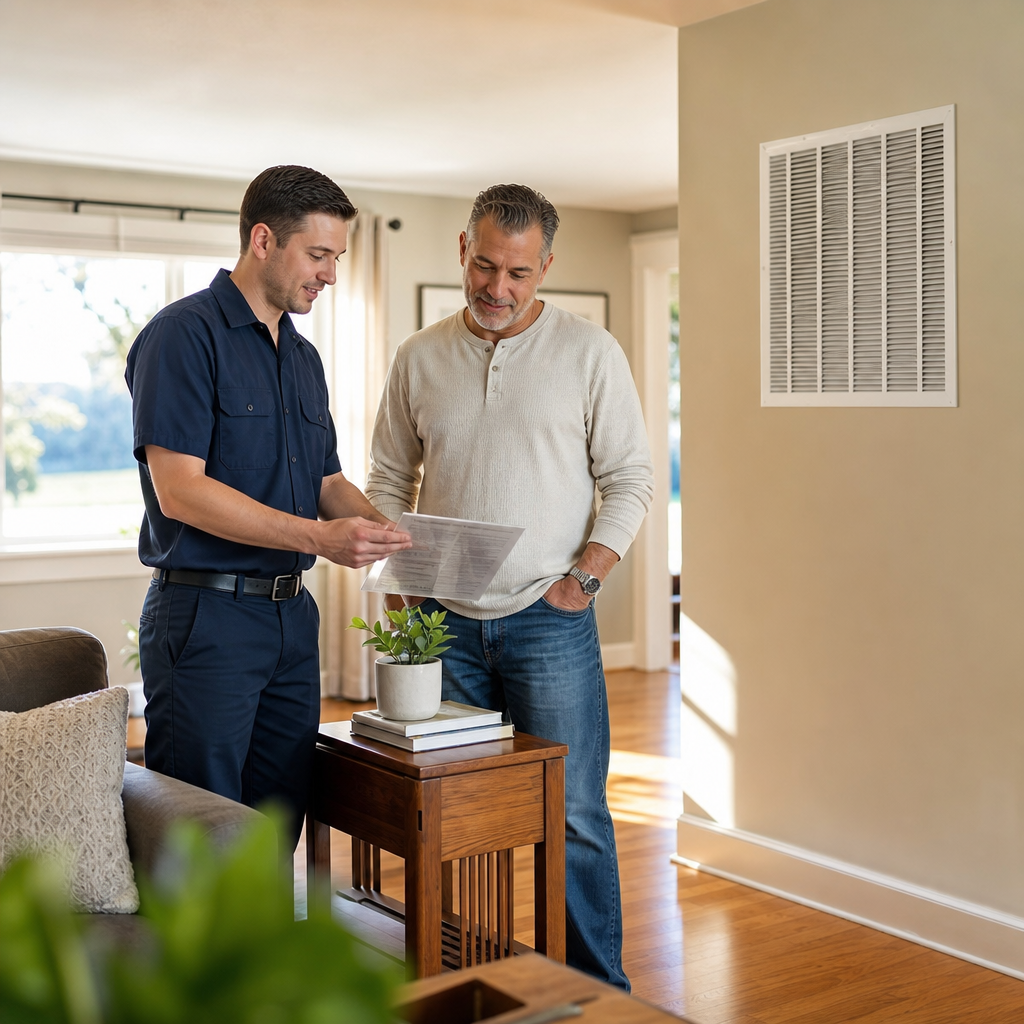
As recommended by Redwood Air Duct Cleaning Service Bridgeport, a comprehensive HVAC inspection evaluates key parts of the system where debris or moisture may collect.
Supply and return trunk lines
Supply ducts carry conditioned air into living spaces, while return trunks direct air back to the air handler. Technicians inspect these lines for damage, disconnected joints, and contamination. Leaky duct sections can draw in unconditioned air or particulates from basements or crawl spaces.[5]
Evaporator coils and condensate drain pans
The indoor evaporator coil removes heat and moisture from the air during cooling cycles, and the condensate pan collects the resulting moisture. Accumulated debris on coils or standing water in drain pans can contribute to biological growth and reduce operating efficiency.
Blower motor assemblies and plenums
The blower wheel circulates air through the HVAC system. Heavy dust accumulation on blower components can reduce airflow and place additional strain on the motor. Inspecting and cleaning these components helps maintain proper system operation.
Air Duct Cleaning and Sanitizing Cost Considerations
Specific price ranges sometimes cited for the Bridgeport area (such as $350 to $700 for basic cleaning or $75 to $200 for sanitizing add-ons) are unverified estimates that are not supported by the supplied research brief. Actual costs vary widely depending on the provider and specific project requirements.[3]
Key factors that shape project estimates include:
- Number of air handlers and vent registers: Multi-zone homes with separate units require additional setup and labor time.
- Duct access and placement: Ducts located in crawl spaces or tight attic configurations may require specialized access and containment measures.
- Level of contamination: Systems with heavy debris, construction dust, or documented contamination may require more extensive cleaning.
- Additional maintenance services: Bundling services such as coil cleaning or duct sealing can influence overall service costs.
Homeowners should request detailed, written estimates outlining the scope of work before authorizing service, a practice standard at Redwood Air Duct Cleaning Service Bridgeport.
How to Choose an Air Duct Cleaning and Sanitizing Service
When selecting a service provider in the Bridgeport area, consumers should verify company qualifications, equipment, and proposed procedures.
Consider the following guidance when evaluating service providers:
- Appropriate cleaning equipment: Confirm the contractor uses vacuum extraction and containment equipment appropriate for the duct type.
- EPA-registered products: If antimicrobial treatment is recommended, ensure the product is EPA-registered for the specific HVAC application, and request the product name and registration information.
- Licensing and insurance: Verify that the contractor holds appropriate trade licenses and liability insurance.
- Clear written procedures and estimates: Request upfront written estimates that specify the exact scope of cleaning and any proposed chemical applications.
- Re-entry and safety information: Ensure the provider supplies label-based re-entry timelines and aeration requirements prior to any application.
Frequently Asked Questions About Air Duct Sanitizing
Is chemical duct sanitization safe for children and pets?
Safety depends on the specific product label, application method, ventilation, occupant exclusion during treatment, proper aeration, and adherence to specified re-entry requirements. Chemical treatments should only be applied according to EPA label directions, and occupants should follow all manufacturer instructions regarding re-entry times.
How often should home HVAC ducts be sanitized?
The EPA does not recommend routine air duct cleaning or sanitizing on a fixed annual or recurring schedule. Sanitizing should only be considered when there is a specific, documented need, such as identified microbial contamination, after thorough physical cleaning. Regular filter changes and routine HVAC maintenance remain important practices.
What sanitizing products do professional duct cleaners use?
Professional duct cleaners must use EPA-registered antimicrobial products specifically labeled for use in HVAC systems. Application methods and surface compatibility depend strictly on manufacturer label instructions for nonporous duct surfaces.
Can dirty air ducts cause high electric bills?
When heavy dirt and debris accumulate on components such as the evaporator coil, blower fan, or registers, airflow can be restricted. This restriction may reduce system efficiency and cause heating or cooling equipment to run longer cycles.
How do I schedule an HVAC duct inspection in Bridgeport?
Contact a qualified local HVAC or duct cleaning professional, such as Redwood Air Duct Cleaning Service Bridgeport, to request an inspection. A technician can inspect accessible ducts, coils, and air handlers to assess debris levels, check for moisture issues, and provide recommendations based on documented system needs.
Need best air duct sanitizing bridgeport?
We’re available now — call for a fast, free estimate.
Sources
- Analysis of Ventilation Data from the – govinfo.gov (2001)
- IAQ Handbook – Ventilation evaluation – Persily – tsapps.nist.gov (2016)
- The Inside Story: A Guide to Indoor Air Quality | CPSC.gov – cpsc.gov
- Improving the Health of Workers in Indoor Environments: Priority … – stacks.cdc.gov
- Highlighted Analysis of the Building Assessment Survey … – epa.gov
Related reading: Commercial Air Duct Cleaning Cost – Call Now-10% Off – Same-Day Service – Free Estimate
Related reading: Is Air Duct Sanitizing Worth It | Call Now-10% Off | Same-Day Service | Free Estimate
Related reading: 24/7 Duct Cleaning Services Bridgeport | Call Now-10% Off | On-Site in 60 Minutes | Free Estimate
Frequently Asked Questions
Can all types of HVAC ductwork be treated with antimicrobial sanitizers?
No, EPA-registered antimicrobial products are strictly approved for nonporous HVAC surfaces, such as bare sheet metal, and should not be applied to porous fiberglass duct boards. Redwood Air Duct Cleaning Service Bridgeport conducts thorough diagnostic inspections to evaluate your system materials and applies targeted treatments only where safely permitted by manufacturer guidelines.
How long does the entire air duct cleaning and sanitizing process take?
A typical residential cleaning and sanitizing service takes between two to four hours, depending on system size, duct accessibility, and the level of buildup. Redwood Air Duct Cleaning Service Bridgeport provides precise timelines along with clear, label-based re-entry and aeration instructions so your family can safely return to the home.
How quickly can I schedule same-day air duct sanitizing in Bridgeport?
You can contact Redwood Air Duct Cleaning Service Bridgeport by phone or text to request a free, no-obligation estimate and book same-day service. Local technicians are dispatched promptly to perform diagnostic evaluations and antimicrobial treatments without corporate delays or hidden fees.
About the author
 |
Sarah Miller Sarah Miller is a certified indoor air quality specialist with over seven years of experience in the HVAC maintenance industry. She holds a Bachelor of Science in Environmental Health from the University of Connecticut and frequently writes about practical strategies for maintaining clean, efficient, and safe home environments. |
Dusty vents or weak airflow at home?
We’re available now — call for a fast, free estimate.
Call Now - Free Estimate