
How Often Should You Clean Your Air Ducts in Bridgeport, CT?
Most Bridgeport homes need affordable air duct cleaning in Bridgeport, CT every 2 to 3 years, not the generic 3-to-5-year interval you’ll find online. That standard recommendation assumes sealed ductwork, controlled humidity, and modern materials — conditions that rarely hold true in Bridgeport’s 1880-to-1930 worker housing stock with its retrofitted forced-air systems and chronic coastal moisture infiltration. For a free, no-pressure assessment of your actual duct condition, call Redwood Air Duct Cleaning Service Bridgeport at (833) 364-5125.
We’re not here to sell you a cleaning you don’t need. Ryan Bell, our Owner & Lead Technician, grew up in Black Rock and has spent eleven years crawling through the exact duct configurations found in East Bridgeport Historic District three-families and Kings Highway East corridor duplexes. The honest answer for how often to clean depends on what your ducts are made of, how they were installed, and whether Bridgeport’s humidity is actively degrading them while you read this.
Why the Internet’s 3–5 Year Answer Fails Bridgeport Homes
The National Air Duct Cleaners Association’s 3-to-5-year guideline was developed using data from newer construction with dedicated duct chases, sealed joints, and controlled indoor environments. Bridgeport’s housing stock violates at least two of those assumptions in most buildings.
Here’s what the generic advice doesn’t account for:
- Retrofitted duct geometry: The two- and three-family worker housing concentrated in neighborhoods like the East Bridgeport Historic District and Barnum–Palliser corridor was originally heated by coal and steam boilers. When forced-air systems were installed in the 1950s–70s, contractors ran flex duct and metal pipe through structural cavities, floor joists, and tight closets — creating irregular runs with dead-end sections and sharp elbows that trap debris at rates modern ductwork never experiences.
- Coastal humidity infiltration: Bridgeport sits directly on Long Island Sound with the highest average relative humidity of any major Connecticut city. That moisture infiltrates poorly sealed older duct systems year-round, creating chronic conditions for mold growth and dust-mite allergen accumulation — particularly in basement air handlers common to converted multi-unit buildings.
- Degrading duct materials: In Black Rock and along Kings Highway East, 1960s–70s HVAC conversions frequently used fiberglass duct board or early flex duct routed around original steam-pipe chases. After fifty-plus years, that material disintegrates into fine particulate that circulates continuously. Cleaning on a fixed schedule won’t solve a material failure problem.
We’ve opened ducts in Bridgeport homes where the “dust” was largely degraded fiberglass lining — a situation where cleaning removes the symptom but the source keeps producing more. That’s why Ryan leads every job personally with our Rotobrush and Nikro systems: to assess whether you’re looking at routine accumulation or active material degradation that changes the entire approach.
Interval Triggers: When Calendar Recommendations Don’t Fit
For Bridgeport’s variable older housing stock, observable conditions beat fixed schedules. We tell homeowners to treat these signals as more reliable than counting years:
- Musty HVAC odor when the system cycles on: This indicates moisture-driven microbial growth inside ductwork, common in Bridgeport’s humid basement air handler configurations. If you smell it every spring and fall, the interval has already expired.
- Visible debris at supply registers: Dark accumulation on vent covers means the system’s airflow is carrying particulate that settled out where velocity drops. In retrofitted ductwork with dead-end runs, this often appears before you’d expect it based on age alone.
- Allergy symptoms that track with system operation: If sneezing, congestion, or eye irritation worsens within minutes of the blower starting — and improves when you leave the house — your ducts are likely circulating concentrated allergen loads.
- Post-renovation contamination: In Bridgeport’s dense attached housing, drywall dust, insulation particles, and VOC-laden debris from one unit’s renovation can infiltrate shared or adjacent ductwork within days. We see this repeatedly in converted multi-family buildings along Post Road and Bridgeport Avenue.
These triggers matter more than calendar time because they reflect actual contamination load, not theoretical averages. A pre-1960 Bridgeport home with original retrofit ductwork and no prior cleaning might hit these thresholds in eighteen months. A well-maintained system in newer construction with sealed ducts and dehumidification might legitimately stretch toward five years.
What Accelerates the Cleaning Interval in Bridgeport?
Certain conditions shorten the realistic cleaning window well below even our 2-to-3-year Bridgeport-adjusted baseline. We don’t mention these to upsell — we mention them because ignoring them wastes money on premature cleaning or wastes health on delayed cleaning.
Pet Ownership
Homes with multiple shedding pets accumulate dander and hair in ductwork at roughly double the rate of pet-free homes. The hair itself isn’t the main problem — it’s the dander protein particles that become airborne, settle in ducts, and recirculate. In Bridgeport’s humid conditions, that dander combines with moisture to create adhesive buildup that standard HVAC filtration won’t capture. If you have two or more indoor pets in a retrofitted duct system, every 2 years is a realistic minimum.
Renovation and Construction
Bridgeport’s housing density means renovation debris doesn’t stay contained. We’ve cleaned ducts in East Main Street Historic District buildings where a kitchen remodel two units over introduced enough drywall dust to coat the entire shared system’s interior. The visible registers looked clean — the trunk lines were gray with powder. If you’ve had any construction activity in your building within the past year, an inspection is warranted regardless of your last cleaning date.
Fiberglass Duct Board Degradation
This is the Bridgeport-specific factor that changes everything. In Black Rock and Kings Highway East corridor homes with 1960s–70s conversions, fiberglass duct board lining begins breaking down after four decades of humidity cycling. The material doesn’t just get dirty — it becomes the source of particulate. Cleaning removes loose debris temporarily, but the degraded surface keeps shedding.
When Ryan encounters this condition during an inspection, he’ll show you the difference between ordinary dust accumulation and active material failure. Sometimes the right response is cleaning plus sealing with Guardsman-rated materials. Sometimes it’s duct replacement in the affected sections. What it’s never is “wait another three years and see.”
What a Proper Cleaning Actually Includes — and What It Costs
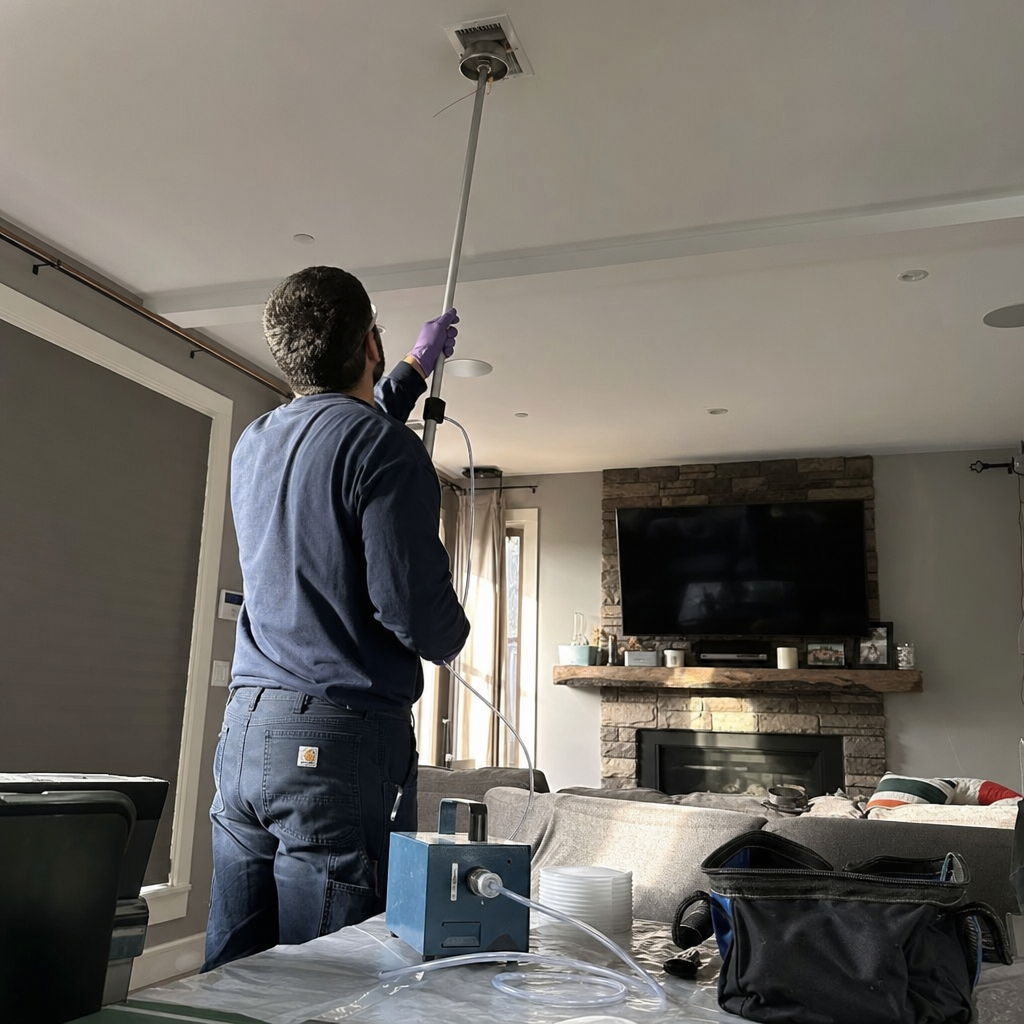
Not all “duct cleaning” in Bridgeport is the same. Discount services often run a vacuum hose into a few registers and call it done. Our Air Duct Cleaning process, which Ryan personally oversees on every job, addresses the full system:
| Component | What’s Done | Bridgeport Price Range |
|---|---|---|
| Supply and return ductwork (full system) | Rotobrush mechanical agitation with HEPA-contained vacuum extraction | $450 – $750 |
| Trunk lines and plenum | Nikro-powered negative-air cleaning with access panel installation where needed | Included in full-system quote |
| Registers and grilles | Removal, hand-cleaning, and reinstallation | Included |
| Air handler / furnace cabinet | Blower wheel and housing cleaning | $150 – $250 add-on |
| Duct sanitizing (mold/microbial) | EPA-registered treatment applied after mechanical cleaning | $125 – $200 add-on |
| Duct sealing (leak reduction) | Mastic or aerosol sealant to improve efficiency and reduce infiltration | $300 – $600 depending on system size |
These ranges reflect Bridgeport’s typical system sizes — smaller two-family conversions at the lower end, larger three-family or multi-zone systems toward the higher end. We’re upfront about this because we’d rather explain it once on the job than have you call back wondering what you paid for.
For homes with active fiberglass degradation, we may recommend our Air Duct Cleaning in Bridgeport combined with Duct Repair & Sealing to address failing material — not just remove debris from it.
How to Tell If Your Ducts Are Actually Due
Ryan’s eleven years of focused duct work in Fairfield County — starting with his training at Housatonic Community College and continuing through nearly 1,100 verified customer reviews — have produced a simple diagnostic framework he applies on every inspection:
- Visual register check: Remove a supply register and photograph the duct opening with your phone. Visible dust buildup more than ¼ inch deep indicates significant upstream accumulation.
- Olfactory test: Stand near a supply vent when the system first cycles on. A musty or “old basement” smell that dissipates after several minutes suggests microbial growth in the ductwork or air handler.
- Filter inspection frequency: If you’re replacing 1-inch pleated filters more than every 6–8 weeks due to visible loading, your ducts are likely contributing particulate faster than the filter can capture.
- System age and history: No record of prior cleaning in a pre-1980 Bridgeport home? Assume the interval is already exceeded. We’ve found original 1970s flex duct in Gateway Village Historic District buildings that had never been accessed.
These checks don’t require tools or training — just attention. If two or more indicators are present, a professional inspection with camera verification is the logical next step.
What Happens If You Wait Too Long in Bridgeport’s Conditions
Delayed cleaning in Bridgeport’s specific environment creates compounding problems that simple vacuuming won’t fully resolve:
Mold colonization in humid trunk lines: Once established, mold requires more than mechanical cleaning — it needs antimicrobial treatment and often moisture-source remediation. The longer it grows, the more extensive the treatment.
Permanent blower wheel contamination: Dust and dander that bypass filters accumulate on the blower wheel, reducing airflow and forcing the motor to work harder. Eventually the wheel requires removal and manual cleaning — a separate service from duct cleaning.
Accelerated duct material failure: In fiberglass-lined systems, accumulated debris holds moisture against the lining surface, speeding degradation. What might have been a cleanable system at year three becomes a replacement candidate at year six.
These aren’t scare tactics — they’re what we find when we’re called to homes that postponed cleaning based on the generic 3-to-5-year guideline. Bridgeport’s coastal humidity and retrofitted duct geometry don’t permit that margin of error.
FAQs
A whole house air duct cleaning cost in Bridgeport, CT typically runs $450 to $750 for standard residential systems, with larger multi-zone or three-family buildings toward the higher end. Add-ons like air handler cleaning ($150–$250) or antimicrobial sanitizing ($125–$200) apply based on actual condition. Call (833) 364-5125 for a free, exact quote — we’ll inspect first and price to what we find.
Repair and sealing is usually more cost-effective than full replacement for retrofitted systems in Bridgeport’s older housing, provided the duct material itself is intact. When we find active fiberglass duct board degradation — common in 1960s–70s conversions in Black Rock and Kings Highway East — replacement of affected sections becomes necessary because the material is the contamination source. Ryan assesses this during every inspection and will show you exactly which condition you’re dealing with before recommending either approach.
Is air duct cleaning worth it in Bridgeport, CT? Yes, significantly — but only when the cleaning addresses the specific allergen loads that humidity-driven environments produce. Bridgeport’s coastal moisture creates ideal conditions for dust mites and mold spores inside ductwork, and standard HVAC filtration doesn’t capture these effectively. Our process using Rotobrush mechanical agitation with HEPA-contained extraction removes accumulated allergen reservoirs, and our Air Quality & Sanitizing service applies treatments that reduce microbial loads. We’ve had customers in the East Bridgeport Historic District report measurable allergy symptom reduction within a week of service.
The most reliable indicator is age and construction type: if your home is a pre-1930 worker housing unit that received forced-air retrofit in the 1960s or 1970s, fiberglass duct board or early flex duct was likely used to navigate around original steam-pipe chases. Visible signs include excessive fine white or gray dust at registers, a “sparkling” quality to settled dust (fiberglass particles), or registers that show degradation when removed. Ryan verifies this with camera inspection during every assessment — we don’t guess, and we don’t sell cleaning where replacement is the honest answer.
When to Call for an Inspection
If you’re counting years since your last cleaning, you’re using the wrong metric for Bridgeport housing. The right questions are: What’s my duct material? What’s my humidity exposure? Am I seeing or smelling signs of contamination? Has there been renovation activity in my building?
After eleven years focused exclusively on duct systems in this market, our honest guidance is simple: pre-1960 Bridgeport homes with original retrofit ductwork should plan on every 2–3 years under normal occupancy, sooner with pets, renovations, or any of the trigger symptoms we’ve described. Newer construction with sealed, dedicated duct chases can stretch toward the standard guideline — but that’s not most of Bridgeport.
If you’d rather have it looked at, Redwood Air Duct Cleaning Service Bridgeport offers a no-pressure assessment in Bridgeport — call (833) 364-5125. Ryan leads every job personally, and if your ducts don’t need service, he’ll tell you straight.
Written by Ryan Bell, Owner & Lead Technician at Redwood Air Duct Cleaning Service Bridgeport, serving Bridgeport, CT.