
Quick Summary
Homeowners searching for indoor air quality sanitizing services near me need clear guidance on resolving persistent musty odors, excessive dust, and potential biological growth in their HVAC systems. As a trusted neighborhood specialist, Redwood Air Duct Cleaning Service Bridgeport emphasizes that chemical sanitization is a conditional step that requires thorough mechanical debris extraction and moisture remediation to truly eliminate airborne contaminants. After reading, homeowners will understand how professional duct sanitization works, what key HVAC components require inspection, and how to schedule a free estimate or same-day service with Redwood Air Duct Cleaning Service Bridgeport.
Indoor Air Quality Sanitizing Services Near Me
If you are dealing with lingering musty odors or dust around vents, searching for local indoor air quality sanitizing services is often a common first step. While marketing claims often promise fast relief, sanitizing is a conditional HVAC treatment that may be appropriate only after thorough mechanical cleaning and only when using a product specifically labeled for HVAC use. Addressing indoor air quality concerns requires understanding what sanitization and remediation actually entail.[4]
Indoor air quality varies substantially by building type, location, ventilation design, and occupancy patterns. According to Redwood Air Duct Cleaning Service Bridgeport, poor air quality in residential homes often stems from contaminants like particulate matter, volatile organic compounds (VOCs), and biological growth inside the ductwork. Applying chemical treatments alone will not solve underlying issues. Proper remediation requires physically cleaning affected hard surfaces, correcting moisture problems, and replacing wet or moldy internal insulation when it cannot be effectively cleaned.[1]
Quick Answer: What to Expect from Professional Air Quality Sanitizing
Quick answer: Professional indoor air quality sanitizing is a conditional treatment that may be appropriate after thorough mechanical cleaning, provided the product is specifically registered and labeled for HVAC use. Sanitizing alone does not guarantee the complete removal of mold, bacteria, or allergens. Moisture problems must be corrected, affected hard surfaces cleaned, and wet or moldy internal insulation replaced when it cannot be effectively cleaned.
What Is the Difference Between Air Duct Cleaning and Sanitizing?
Homeowners often hear duct cleaning and duct sanitizing used interchangeably, but they perform distinct roles:
- Air Duct Cleaning: This is a physical process. Technicians connect vacuum collection systems under negative pressure and run mechanical agitation tools (such as rotary brushes and air whips) through supply and return runs to dislodge and extract dust, debris, and particulate matter.
- Air Duct Sanitizing: This is a conditional antimicrobial treatment that may be applied after mechanical cleaning. It should only be used when an antimicrobial product is specifically registered and labeled for HVAC applications on non-porous system surfaces.
Antimicrobial Treatments and Dirty Surfaces
Antimicrobial treatments should never be applied directly over dirty ductwork without prior mechanical cleaning. Applying chemicals over dust and debris is ineffective because disinfectants cannot properly contact underlying duct surfaces. As noted by Redwood Air Duct Cleaning Service Bridgeport, sanitizing products are only intended as conditional applications on clean, non-porous surfaces when specifically labeled for HVAC use.
| Service Approach | Physical Debris Extraction | Biological Treatment | Expected Outcome |
|---|---|---|---|
| Mechanical Cleaning Only | Full removal using mechanical agitation and negative air | None | Removes accumulated physical debris from accessible duct surfaces |
| Chemical Application Without Cleaning | None (debris remains in vents) | Applied over uncleaned surfaces | Ineffective; chemicals cannot properly reach underlying duct surfaces |
| Mechanical Cleaning with Conditional Sanitizing | Full mechanical brush and vacuum extraction | EPA-registered application specifically labeled for HVAC use | Cleans physical debris; conditional treatment applied to clean surfaces if warranted |
What Are the Signs That an HVAC System May Require Inspection?
Need indoor air quality sanitizing services near me?
We’re available now — call for a fast, free estimate.
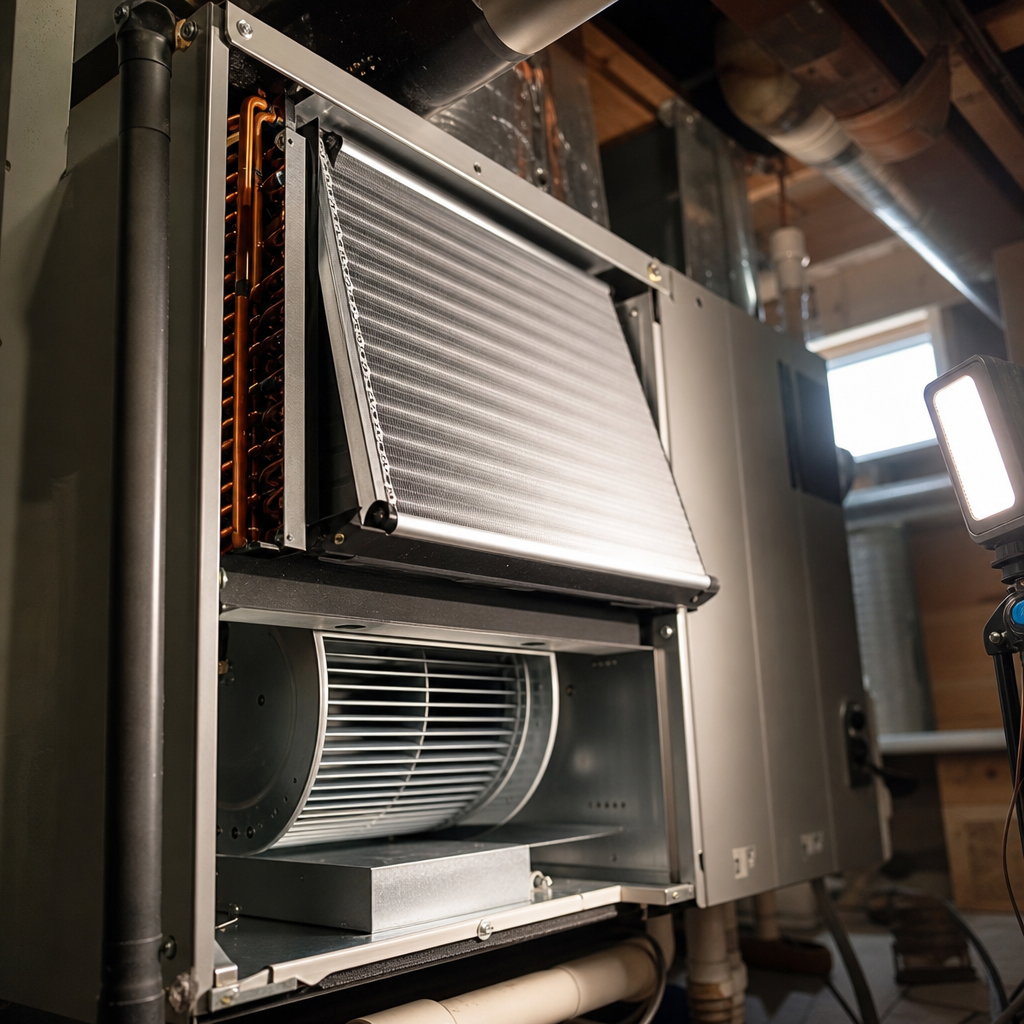
Duct systems run out of sight, but several observable conditions indicate that an HVAC system should be inspected:
- Musty Odors When the System Runs: A persistent damp or moldy odor when airflow begins can indicate moisture accumulation or biological growth inside the system.
- Visible Growth Around Vents and Registers: Visible discoloration or biological growth on supply grilles, register boots, or inside the air handler plenum indicates contamination requiring professional evaluation.
- Excessive Dust Buildup: Unusually heavy particulate accumulation near registers or on surfaces may indicate leaks in ductwork or filtration issues.
- Recent Water Damage or HVAC Drainage Issues: Standing water in condensation pans, drain line clogs, or plumbing leaks near ductwork require prompt correction of moisture sources and inspection of system components.
Which HVAC Components Require Professional Evaluation?
A thorough indoor air quality service, as practiced by Redwood Air Duct Cleaning Service Bridgeport, evaluates the entire air distribution system rather than just blowing air through the wall vents:[2]
- Evaporator Coils: Moisture naturally condenses on cooling coils during operation. If dust bypasses filtration, it can accumulate on wet coil fins and create conditions favorable to biological growth.
- Condensate Drain Pans and Lines: Standing water in a clogged drain pan can harbor biological contaminants and release odors into the airstream.
- Blower Motor and Fan Housing: Dirt coating the blower wheel reduces airflow balance, stresses the motor, and spreads particulates into the duct network.
- Supply Plenums and Trunk Lines: The main supply trunk directly downstream from the air handler experiences high humidity levels, making it a priority zone for inspection.
How Much Do Indoor Air Quality Sanitizing Services Cost?
Pricing for professional HVAC cleaning and sanitizing varies based on multiple factors rather than flat rates. Specialists like Redwood Air Duct Cleaning Service Bridgeport suggest that homeowners should request itemized estimates based on home size, HVAC configuration, contamination levels, required cleaning or remediation, and treatment suitability.[5]
Legitimate pricing is based on clear, verifiable factors:
- Home Size and HVAC Configuration: The number of HVAC units, zones, and overall layout impact the scope and time required.
- Duct Material and Accessibility: Flex duct, sheet metal, and duct board in attics or crawl spaces each require specific handling methods.
- Contamination Level and Remediation Needs: Systems with active moisture intrusion or biological growth require proper remediation procedures, including moisture control and insulation replacement where necessary.
- Scope of Work and Treatment Suitability: An itemized estimate should clearly state which components (such as coils, blowers, and plenums) are included and whether antimicrobial treatments are appropriate and labeled for the specific application.
Frequently Asked Questions
What is the difference between air duct cleaning and air duct sanitizing?
Air duct cleaning uses mechanical agitation and negative-pressure vacuums to physically remove dirt, debris, and particulate matter from duct lines. Air duct sanitizing is a conditional treatment applied after cleaning that uses an EPA-registered antimicrobial solution specifically labeled for HVAC systems on non-porous surfaces.
Does air duct sanitization effectively remove mold, mildew, and bacteria?
Sanitizing alone is insufficient and does not guarantee complete removal of mold, mildew, or bacteria. Effective remediation requires that underlying moisture problems be identified and corrected, affected hard surfaces be physically cleaned, and wet or moldy internal insulation be replaced when it cannot be effectively cleaned. Antimicrobial products must be specifically labeled for HVAC use and applied only to clean surfaces.
Are the chemicals used in HVAC and air duct sanitizing safe?
As emphasized by Redwood Air Duct Cleaning Service Bridgeport, any antimicrobial treatment applied to an HVAC system must be EPA-registered and specifically labeled for HVAC applications. Safety and effectiveness depend on product-specific evidence and strict adherence to manufacturer label instructions, including application methods and precautions.
How often should you have your home indoor air quality sanitized?
The EPA does not recommend routine calendar-based sanitizing for every home HVAC system. Instead, decisions should be based on observed contamination or specific system conditions. For routine maintenance, the National Air Duct Cleaners Association (NADCA) recommends visual cleanliness inspections of residential air-handling units annually and specified duct inspections every two years.
How does ventilation impact indoor air quality?
Ventilation directly affects the concentration of indoor contaminants. The EPA identifies ventilation improvements as a measure that can reduce airborne transmission indoors and reports benefits including improved work performance, reduced absenteeism, and reduced illness.[3]
Need indoor air quality sanitizing services near me?
We’re available now — call for a fast, free estimate.
Sources
- What is Indoor Air Quality? – U.S. Environmental Protection … – epa.gov (2025)
- Indoor Air Quality 2024 Transition Briefing Paper – epa.gov (2024)
- Household air pollution and related health impacts – who.int (2025)
- Evidence from Scientific Literature about Improved … – epa.gov (2005)
- Air Quality Matters podcast: a call to action for healthy homes – linkedin.com (2025)
Related reading: Commercial Air Duct Cleaning Cost – Call Now-10% Off – Same-Day Service – Free Estimate
Related reading: Is Air Duct Sanitizing Worth It | Call Now-10% Off | Same-Day Service | Free Estimate
Related reading: 24/7 Duct Cleaning Services Bridgeport | Call Now-10% Off | On-Site in 60 Minutes | Free Estimate
Frequently Asked Questions
Can moldy duct insulation be sanitized, or does it require replacement?
Antimicrobial sanitizing solutions are only effective on clean, non-porous surfaces, meaning porous fiberglass or internal duct insulation with active biological growth must be physically replaced. Redwood Air Duct Cleaning Service Bridgeport evaluates your system to identify damaged insulation and ensures proper removal rather than masking issues with ineffective surface sprays.
How long does a professional air duct cleaning and sanitizing service take?
A comprehensive inspection, mechanical cleaning, and conditional sanitizing visit typically takes between two and four hours depending on the size and condition of your HVAC system. Redwood Air Duct Cleaning Service Bridgeport offers flexible scheduling, including same-day service, to resolve urgent air quality concerns quickly.
How do I get an honest price estimate for indoor air quality sanitizing services near me?
Legitimate pricing requires an evaluation of duct accessibility, layout, and actual contamination levels rather than arbitrary flat rates. Redwood Air Duct Cleaning Service Bridgeport provides transparent, itemized estimates with no hidden costs or high-pressure upsells.
About the author
 |
David Larson David Larson is an indoor air quality specialist with over 8 years of experience in HVAC maintenance and commercial duct cleaning. He holds an associate degree in Heating, Ventilation, and Air Conditioning Technology from Porter and Chester Institute. David is passionate about helping Bridgeport residents and business owners breathe cleaner air and improve system efficiency. |
Dusty vents or weak airflow at home?
We’re available now — call for a fast, free estimate.
Call Now - Free Estimate